Last updated 2026-08-18
TL;DR
Alabama does not have a standalone wildlife rehabilitator board. The Division of Wildlife and Freshwater Fisheries issues the required Wildlife Rehabilitation Permit. You need the permit before possessing native wildlife, and most birds also require a federal migratory bird permit. Plan for a facility inspection, $25 state fee to confirm, and $75 federal bird application fee. Timeline is months, not weeks.
Is there a wildlife rehabilitator board in Alabama?
No. Alabama has no standalone wildlife rehabilitator board, commission, or licensing board for rehabbers. The program sits inside the Alabama Department of Conservation and Natural Resources, specifically the Division of Wildlife and Freshwater Fisheries. That division writes the rule, accepts the application, approves facilities, and can revoke the permit [2]. People say board because other states have one, but in Alabama your point of contact is a district wildlife biologist or enforcement officer, not a separate board.
This matters because you cannot call a licensing board for forms. You go through the Wildlife and Freshwater Fisheries permit path. The governing statute requires a permit issued by the Commissioner of Conservation and Natural Resources [1]. When someone asks which board oversees wildlife rehab in Alabama, the accurate short answer is no board. The DCNR division is the authority. The regulations use the word permit, not license or board registration [2].
Do you need a license to be a wildlife rehabilitator in Alabama?
Yes. Alabama calls it a Wildlife Rehabilitation Permit, but it functions as the license. The statute is blunt: no person shall possess protected wildlife for rehabilitation unless they have "secured a permit from the Commissioner of Conservation and Natural Resources" [1]. If you take in a protected native bird, mammal, or reptile without this permit, you can face state wildlife penalties. The permit is not a veterinary license and does not let you treat animals as a veterinarian.
You do not need a state permit if you are only transporting an injured animal to a permitted rehabilitator, but you cannot hold or treat it. The rule covers possession for rehabilitation, not emergency transport [2]. If you want to rehab migratory birds, the state permit is only half the paper. You also need a federal permit from U.S. Fish and Wildlife Service for most wild bird species [3]. Alabama will not approve bird rehabilitation without that federal piece.
Who issues Alabama wildlife rehabilitation permits?
The Alabama Division of Wildlife and Freshwater Fisheries issues state wildlife rehabilitation permits. The application goes through the district office that covers your county, and a district wildlife biologist or conservation enforcement officer usually does the facility inspection [2]. You mail or deliver the completed application and fee. The Division reviews your experience, facility, and record. The Commissioner has broad authority to deny, condition, or revoke [1].
Because Alabama does not have a board, there is no separate board hearing unless you appeal through the department. The practical path is to call your nearest Division of Wildlife and Freshwater Fisheries district office, ask for the wildlife rehabilitation permit packet, and get the current checklist. The permit is not a business permit from a county. Some counties may still require local zoning sign-off for home animal care, but the state permit itself comes from DCNR.
How much does it cost to become a wildlife rehabilitator in Alabama?
Official application fees are small. The state regulation lists a $25.00 nonrefundable wildlife rehabilitation permit application fee, and U.S. Fish and Wildlife Service charges a $75.00 migratory bird rehabilitation application fee if you take birds [2][4]. The big cost is not paperwork. It is caging, a dedicated freezer, syringes, diets, and veterinary supplies, which commonly pushes a first-year home setup from $500 to $3,000.
The $25 state fee does not include facility upgrades, inspection corrections, or the federal bird permit. If you plan to rehab only mammals and no birds, you still need the state permit but skip the federal bird fee. Do not assume a $25 application means you can start cheap. A raccoon or opossum enclosure needs proper substrate, heat, isolation space, and secure hides. You cannot use pet crates long term.
| Cost item | Published or typical | Source |
|---|---|---|
| State application fee | $25.00 nonrefundable | Ala. Admin. Code r. 220-2-.154 |
| Federal migratory bird rehab fee | $75.00 | 50 CFR 13.11(d) |
| Basic caging and supplies, first year | $500 to $3,000 | honest range, no state study |
How long does it take to become a wildlife rehabilitator in Alabama?
Plan on 3 to 6 months from first call to first legal intake. Alabama does not publish a statutory processing clock, and the timeline is driven by how fast you build or correct your facility, schedule the district inspection, and get your federal bird permit if you need one [2]. Some people finish in 60 days. Others take a year when they need expensive enclosure changes.
The state side can move in weeks once the inspection passes, but the inspection often reveals fixes: you need a separate quarantine area, a washable floor, or better predator-proofing. The federal migratory bird permit path has its own application and processing time. USFWS does not guarantee a date, and you should allow extra weeks before taking in any native bird [3][5]. Do not count a timeline until the inspection report is signed off.
Alabama wildlife rehabilitation permit requirements
The state rule sets the baseline: you must be at least 18, complete the application, pay the fee, and have a facility that meets the Division's inspection standards [2]. Alabama also looks at your wildlife violation record. A prior conviction under state game and fish law can block a permit [1]. You should list the species you intend to hold and have written approval for each.
Most first-year Alabama rehabbers start with common small mammals such as eastern gray squirrels, Virginia opossums, and eastern cottontails. Larger or high-risk species usually require more facility, more experience, and sometimes a written letter from a permitted mentor or veterinarian. Alabama does not require you to pass a board exam the way some states do, but you still have to show working knowledge of species diets, zoonotic risk, and release criteria in the application and inspection [2]. Confirm current requirements with the Division because district offices can ask for local proof.
Do you need a federal bird permit in Alabama?
Yes, for almost all wild birds. The state permit lets Alabama DCNR regulate you, but the Migratory Bird Treaty Act makes U.S. Fish and Wildlife the authority for most native bird species [9]. You need a separate Migratory Bird Rehabilitation permit before you can legally possess a blue jay, mockingbird, hawk, owl, or songbird for rehab. The federal application fee is published at $75, and you also need an Alabama state permit before USFWS will finalize the bird permit in most cases [4][5].
Birds are where people accidentally break the law. Even if you have a state wildlife rehab permit, holding a northern cardinal without the federal permit is a federal offense. If you only want to rehab mammals, skip the federal bird permit. But many Alabama rehabbers take in both, and then the paper path doubles. The federal permit is one application, not per species.
Facility and cage standards Alabama expects
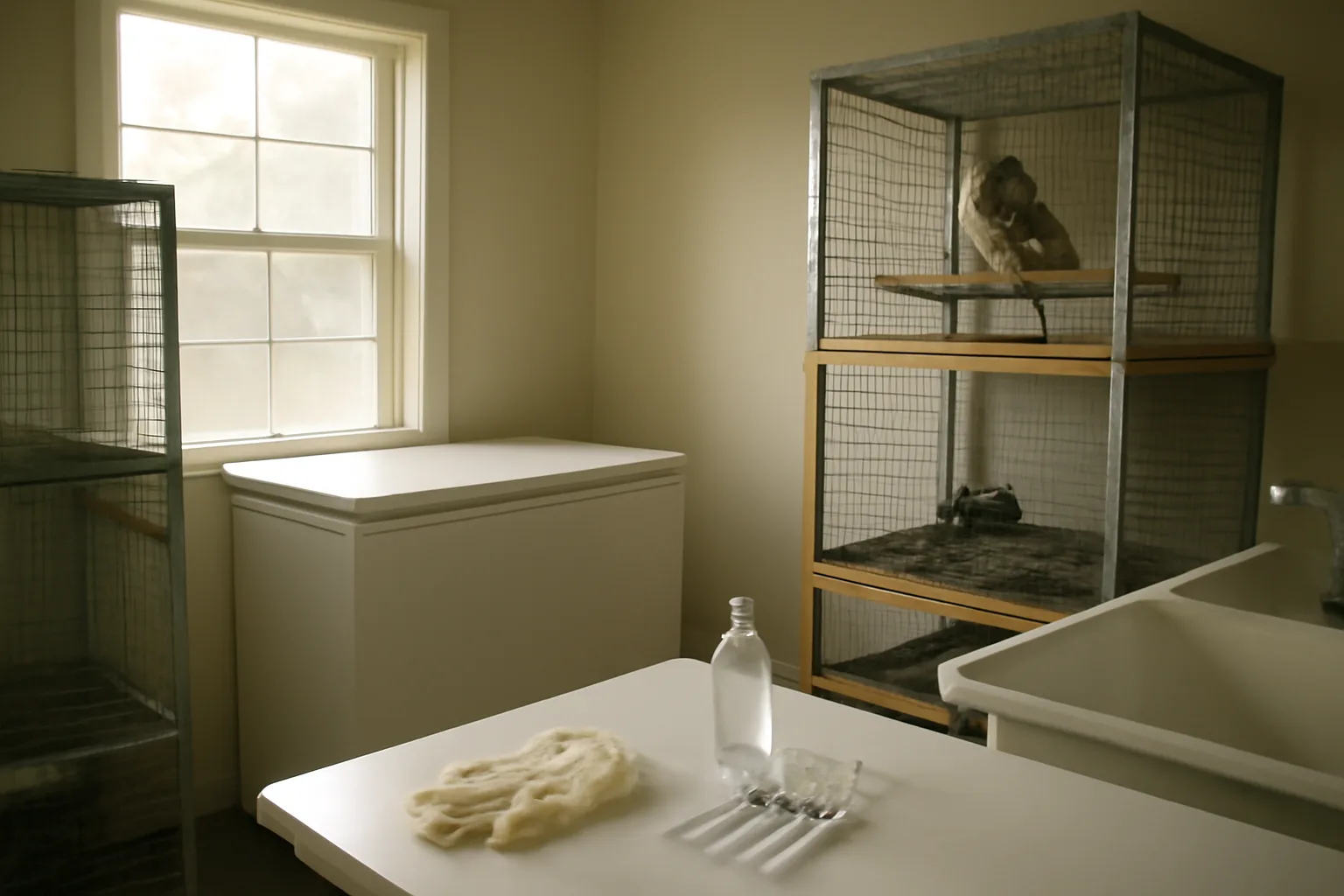
Alabama has no published square footage chart for every species, but the inspection is real. You need separate areas for quarantine, inpatient, and pre-release, plus a way to wash hands and clean surfaces without cross-contaminating animals [2]. A spare bathroom can work for quarantine. A chain-link dog run can become a pre-release space for adult squirrels, but it needs a top, a predator apron, and shade.
Expect the inspector to look at food storage, freezer capacity, waste disposal, and escape prevention. Rodents and raccoons chew, so wood frames fail faster than galvanized wire and plastic. We tell readers to skip aquarium tanks for mammals: bad ventilation and bad sanitation. Use wire enclosures with solid floors. National standards can help you set up before the state inspection, but Alabama's inspector is the approval that counts [7]. For rabies vector species such as raccoons, foxes, skunks, and bats, state and federal public health guidance adds a heavier responsibility [6][10].
How to apply for an Alabama wildlife rehabilitation permit
First, call your ADCNR Division of Wildlife and Freshwater Fisheries district office, not Montgomery. Ask for the current wildlife rehabilitation permit application and inspection checklist. Second, build or adapt your facility to the checklist before you submit, because the application asks for species and enclosure descriptions. Third, file the application and the state fee, currently listed at $25, and keep a copy [2]. Fourth, schedule the inspection. Fifth, if you want birds, file your federal migratory bird rehabilitation application with USFWS and note your state permit number when it issues [3][5].
Do not take in an animal as a reason to speed up the permit. Alabama does not give an emergency permit to unpermitted members of the public. If you find injured wildlife before you are legal, call a permitted Alabama rehabilitator or a district wildlife officer. The Department lists wildlife rehabilitators by county, but the list changes, so confirm by phone [8].
What species can you rehabilitate in Alabama?
Your permit will list approved species. New rehabbers should start with a short list, not the whole native fauna. Eastern gray squirrels, eastern cottontails, and Virginia opossums are the common Alabama entry points because their diets and housing are relatively simple. White-tailed deer and black bears are not a first-year project. Both trigger heavier state oversight, larger pens, disease testing, and often herd or population-level rules [2].
Bats, skunks, foxes, and raccoons carry rabies and put you in a different risk category. CDC guidance treats these as rabies vector species, which means safe handling, pre-exposure vaccination in many cases, and strict isolation are nonnegotiable [6]. If a member of the public finds a bat inside a house, Alabama public health often directs them to contact county health before wildlife rehab [10]. Keep your species list conservative until you have a mentor and a veterinarian who will see wildlife in hand.
First-year budgeting and what to skip in Alabama
Do not spend your budget on a wall full of name-brand pet crates. Buy galvanized wire panels, solid plastic trays, and a chest freezer first. The state permit fee is small, but the real money is in enclosures, formula, syringes, heating pads without automatic shutoff, and veterinary care. If you cannot fund emergency vet care for an intake, you are not ready, regardless of what the application fee costs.
We see new rehabbers overspend on decorative enclosures and underspend on sanitation. A used upright freezer for whole prey and milk replacers is a better purchase than another cage. For around $500 to $1,500, a single-species small mammal setup is realistic if you build it yourself and buy used. Raptors and waterfowl cost more because they need flight pens and pools. Use a written budget, not a vibe. If you are building multi-species enclosures, WildlifeRehabPath's $149 State + USFWS Enclosure Kit at /start gives the state and federal paper checklist in one place; it does not replace the actual permits.
How Alabama compares to nearby states
Alabama's no board, permit only structure is simpler than Florida's program but less formal than some states that require tests or minimum hours. In Florida and Georgia, the wildlife agency also issues permits, but fees, inspection timing, and species rules differ. If you live on the state line, do not assume your Alabama permit transfers. It does not. You need a separate permit in each state where you accept wildlife. We keep state-specific walkthroughs for Florida and Georgia updated.
For the strongest southern comparison, look at Arkansas, another permit program with district inspections. If you plan to focus on birds, the federal bird permit is the same across all states, but state facility standards still differ. For a broader contrast on how a large state structures the same federal bird rules, see Illinois. Before you expand across state lines, call both state offices. Nothing about an Alabama permit preapproves you elsewhere.
Frequently asked questions
Do you need a license to be a wildlife rehabilitator in Alabama?
Yes. Alabama requires a state Wildlife Rehabilitation Permit from the Division of Wildlife and Freshwater Fisheries before you possess protected native wildlife for rehabilitation. It functions as a license. Most birds also need a federal Migratory Bird Rehabilitation permit. A veterinary license is not required, but access to wildlife veterinary care is expected.
How much does it cost to become a wildlife rehabilitator in Alabama?
Published state application fee is $25.00, and USFWS migratory bird rehab fee is $75.00 if you take birds. The larger cost is cages, freezer, formulas, and vet supplies. A simple small-mammal setup may run $500 to $1,500. Bird flight pens and pools make it $2,000 up. Confirm current fees.
How long does it take to get an Alabama wildlife rehab permit?
Usually 3 to 6 months from first call to approval. Alabama publishes no statutory deadline. Facility inspection fixes and federal bird permitting add time. Some finish in 60 days if the facility passes quickly. Larger raptor or deer pens can take a year.
Is there a wildlife rehabilitator board in Alabama?
No. Alabama has no separate board. The Division of Wildlife and Freshwater Fisheries within DCNR handles applications, inspections, and permit authority. The Commissioner issues the permit under Code of Alabama section 9-11-235.
Can I rehabilitate a baby squirrel in Alabama without a permit?
No. Eastern gray squirrels are protected native wildlife. Possessing one for rehabilitation without the state permit is a wildlife violation. If you find an injured squirrel, call a permitted Alabama rehabilitator or a district wildlife officer. Do not keep it while you wait.
Does Alabama require a test to become a wildlife rehabilitator?
No state board exam is required. You submit an application, pay the state fee, and pass a facility inspection. The division may ask for species knowledge and experience, especially for high-risk mammals and raptors. Training through NWRA or IWRC courses helps, but it is not a statutory test.
Can you rehabilitate deer in Alabama?
In most cases, no for first-year rehabbers. White-tailed deer require large pens, disease testing, and additional oversight from the Division. If you find an uninjured fawn, leave it alone. Injured or orphaned deer go to a permitted fawn rehabber or district wildlife office.
Can you rehabilitate birds in Alabama with only a state permit?
No. Almost all native birds also require a U.S. Fish and Wildlife Service Migratory Bird Rehabilitation permit. The $75 federal application fee is separate. A state permit alone does not authorize you to hold a songbird, raptor, or waterfowl for rehabilitation.
What happens during the Alabama facility inspection?
A district wildlife biologist or enforcement officer checks housing, quarantine, sanitation, food storage, waste disposal, and escape prevention. You need separate spaces for quarantine and pre-release. The inspector can require corrections before the permit issues. You do not need a clinical hospital.
Does Alabama allow home-based wildlife rehabilitation?
Yes, most Alabama rehabbers operate from home. The state permit is for possession, not a commercial facility license. Local zoning may still restrict animal care businesses or heavy outdoor enclosures, so check your county or city from the start.
How do I find a permitted wildlife rehabilitator in Alabama?
Call the ADCNR Division of Wildlife and Freshwater Fisheries district office in your county. The department keeps a county list, but it changes, so phone confirmation works best. For after-hours emergencies, contact a district wildlife officer or local animal control, more than social media.
Does Alabama accept wildlife rehabilitator permits from other states?
No. A Florida or Georgia permit does not authorize you to rehabilitate Alabama wildlife. You must hold an Alabama permit for animals found in Alabama. Federal bird permits can cover multiple states, but state facility approval still happens in each state.
Sources
- Code of Alabama 1975, Section 9-11-235: Requires a permit from the Commissioner of Conservation and Natural Resources before possessing protected wildlife for rehabilitation.
- Alabama Administrative Code r. 220-2-.154, Rehabilitation of Wildlife: Sets the state wildlife rehabilitation permit application process, facility inspection, and the published $25.00 nonrefundable fee.
- 50 CFR 21.31, Rehabilitation permits: Federal regulation requiring a permit to possess migratory birds for rehabilitation.
- 50 CFR 13.11(d), Application fees for permits: Federal migratory bird rehabilitation permit application fee is $75.00.
- Centers for Disease Control and Prevention, Rabies: Bats, skunks, foxes, and raccoons are rabies vector species requiring strict isolation and safe handling.
- National Wildlife Rehabilitators Association, Minimum Standards for Wildlife Rehabilitation: National best-practice standards for wildlife rehabilitation facilities, often used before state inspection.
- U.S. Fish and Wildlife Service, Migratory Bird Treaty Act Protected Species: Migratory Bird Treaty Act protects most native bird species and establishes federal authority.
- Alabama Department of Public Health, Rabies: Alabama public health guidance directs rabies vector wildlife concerns to county health authorities.