Last updated 2026-08-18
TL;DR
Arkansas has no state wildlife rehabilitator license or board. The Arkansas Game and Fish Commission does not issue rehab permits. Birds run through the federal system: a Migratory Bird Rehabilitation permit (Form 3-200-10b) from the U.S. Fish and Wildlife Service, and sometimes a special purpose permit. You need a licensed Arkansas vet to sponsor you, a finished enclosure, and you follow federal and state wildlife law. Mammals need no state permit at all.
Do you need a license for wildlife rehabilitator in Arkansas?
Yes, but not from Arkansas. The state does not license wildlife rehabilitators. The Arkansas Game and Fish Commission (AGFC) has no wildlife rehabilitation permit category. To rehabilitate most native birds in Arkansas you need a federal Migratory Bird Rehabilitation permit from the U.S. Fish and Wildlife Service (USFWS) [1]. For mammals, Arkansas has no permit at all, which surprises people. You still follow state possession laws and federal rules.
The permit that matters comes from USFWS Region 4, which covers Arkansas. Form 3-200-10b is the Migratory Bird Rehabilitation application. If you plan to work with eagles or other federally protected non-migratory species, you may need a separate special purpose permit. For reptiles and amphibians, Arkansas has no rehab permit requirement, but taking certain native species from the wild can require a collection permit from AGFC [2].
Here is what that means day to day. You can legally rehab a gray squirrel or an opossum in Arkansas with zero state paperwork, as long as you meet local zoning and possession laws. For a robin or a barred owl, you need the federal permit. Nobody at the county level issues a wildlife rehab license. The closest thing to a wildlife rehabilitator board in Arkansas is your regional USFWS permit office, and for mammals, it is your own veterinarian sponsor.
How much does wildlife rehabilitator cost in Arkansas?
The federal application fee for a Migratory Bird Rehabilitation permit is $100. That fee sits under the authority in 50 CFR 13.11, and you should confirm the current amount before you file because the regulation lets the agency update it [3]. There is no Arkansas state permit fee because there is no state permit. The real money goes into the enclosure, not the paperwork.
A basic outdoor flight enclosure for songbirds runs $500 to $1,500 if you build it yourself with hardware cloth, 2x4s, and a concrete or paver floor. A raptor mew costs more, often $2,000 to $5,000 depending on size and whether you buy a prefab panel system. Add a $150 to $400 veterinary exam for your first intake and roughly $200 to $600 a year in food, bedding, heat lamps, and medical consumables. WildlifeRehabPath sells a $149 State + USFWS Enclosure Kit with measured plans and a permit checklist if you want a shortcut, but you can do the paperwork yourself for free.
No agency publishes an average startup cost for Arkansas. Here is the honest estimate built from the federal permit fee and typical build costs: budget $1,000 to $3,000 your first year if you build everything yourself, more if you hire a contractor for the enclosure. The permit fee is the smallest line on the page.
How long does wildlife rehabilitator take in Arkansas?
Plan on 60 to 90 days for the federal permit in a normal year. USFWS Migratory Bird Rehabilitation permits are processed by the regional office in Atlanta, and that office carries a backlog that shifts by quarter. There is no published average processing time for Arkansas applicants, so treat 60 to 90 days as a planning range, not a promise [4]. Incomplete enclosure photos or a missing veterinarian letter bounce the application back and add 30 to 45 days.
Building the enclosure usually takes longer than the paperwork. A DIY songbird flight enclosure takes one to three weekends. A raptor mew with proper perching, drainage, and a double-door entry can eat a month of weekends. The vet sponsorship takes as long as it takes to find a licensed Arkansas veterinarian who will sign your permit and agree to see your animals. That is the step that stalls people most.
From first research to legal first intake, count on four to six months. Some people clear it in 90 days because they already have a vet sponsor, a finished enclosure, and a clean application. Others take nine months when the enclosure and permit revisions pile up cycles.
Who actually oversees wildlife rehab in Arkansas?
Three agencies split authority over wildlife rehabilitation in Arkansas. The U.S. Fish and Wildlife Service Region 4 office in Atlanta issues and enforces the Migratory Bird Rehabilitation permit. AGFC enforces state possession laws and controls which native species you can take from the wild [2]. The Arkansas State Veterinarian's office and the Arkansas Veterinary Medical Examining Board regulate the veterinary side, so your sponsor has to be a licensed Arkansas veterinarian in good standing.
There is no Arkansas wildlife rehabilitator board. No board approves your enclosure in person. No state inspector signs off on your operation. Your federal permit is an administrative approval, not an in-person inspection, unless USFWS decides to audit you. That catches a lot of new rehabbers off guard, because they expect a site visit before they can start.
Endangered species change the math. For a red-cockaded woodpecker, you would need an additional endangered species permit from USFWS. For game animals like white-tailed deer fawns, AGFC has specific possession rules, and many rehabbers skip deer entirely because of chronic wasting disease restrictions [5].
What the federal permit actually requires in Arkansas
Form 3-200-10b asks for your contact information, a description of your facilities including square footage and construction materials, photos of the enclosure, a letter from a licensed veterinarian agreeing to sponsor you, and a statement of your experience or training [1]. USFWS wants to see that you have either worked under a permitted rehabilitator or completed recognized training, such as International Wildlife Rehabilitation Council (IWRC) or National Wildlife Rehabilitators Association (NWRA) courses.
Your enclosure has to prevent escape, protect birds from predators, shelter them from weather, and allow quarantine of new intakes. The standard lives in 50 CFR 21.31, which covers migratory bird rehabilitation permits. The regulation says facilities must be "adequate to properly care for the birds" and that the applicant must have "appropriate experience" [6]. That is the entire federal standard. It is intentionally vague, so your veterinary sponsor's letter is what tips an application from review to approval.
You also need a records system. USFWS requires daily records for each bird: species, date received, condition, treatment, and final disposition. You hold those records for five years and submit an annual report to the regional office. Skip the annual report and your renewal gets denied. Renewal comes up every five years.
What wildlife can you rehabilitate in Arkansas without a permit?
Mammals. White-tailed deer, gray squirrels, fox squirrels, eastern cottontails, opossums, raccoons, skunks, and bats can be rehabilitated in Arkansas with no state rehab permit, because no such permit exists. That sets Arkansas apart from Texas, Louisiana, and Missouri, which all run state rehab permit systems. Rehabbing a raccoon here is legal by default, as long as you stay inside local ordinances.
There are real caveats. Bats in Arkansas are a rabies vector species, and the Arkansas Department of Health warns unvaccinated people against handling them [7]. Raccoons and skunks carry the same risk. You can rehab them legally, but you carry personal liability that a permit system would normally handle through vaccination and reporting rules.
Deer are legal to rehab without a state permit, but AGFC bars keeping any wild animal as a pet past the rehab period, and you release it in the county where it was found or within a reasonable distance [2]. Non-releasable animals need a separate authorization. For deer, that rarely comes through because of the CWD problem in north Arkansas.
The vet sponsor is the actual gatekeeper in Arkansas
Your veterinarian sponsor carries more weight in Arkansas than in states with a board. In Alabama or Georgia, the state wildlife agency reviews your application and the vet letter is one document among several. In Arkansas, the USFWS regional office reviews your application without an in-person site visit in most cases, so the vet letter is the main quality signal they have.
The letter needs to state that the veterinarian has reviewed your facility (usually from your photos), agrees to provide medical care or oversight for your animals, and believes you have adequate training. Some Arkansas vets sign after one meeting. Others say no flat out, because they do not want the liability or the after-hours calls when a rehabber shows up with a broken-winged hawk at 9 p.m.
Here is what I would do. Call rural and mixed-animal clinics before urban small-animal practices. Vets who already treat wildlife as a community service, or who work with AGFC's wildlife health program, are the likeliest to sign. Expect a sponsorship fee somewhere between zero and a few hundred dollars. No fee is mandated, and charging one is up to each practice.
The enclosure: what passes in Arkansas without a board inspection
Since no board inspects you, your enclosure photos are the entire facility review. USFWS wants clear photos showing dimensions, construction materials, a secure top, and a quarantine area separated from the main enclosure. Shoot in daylight, put a tape measure in at least one frame, and take photos from inside and outside.
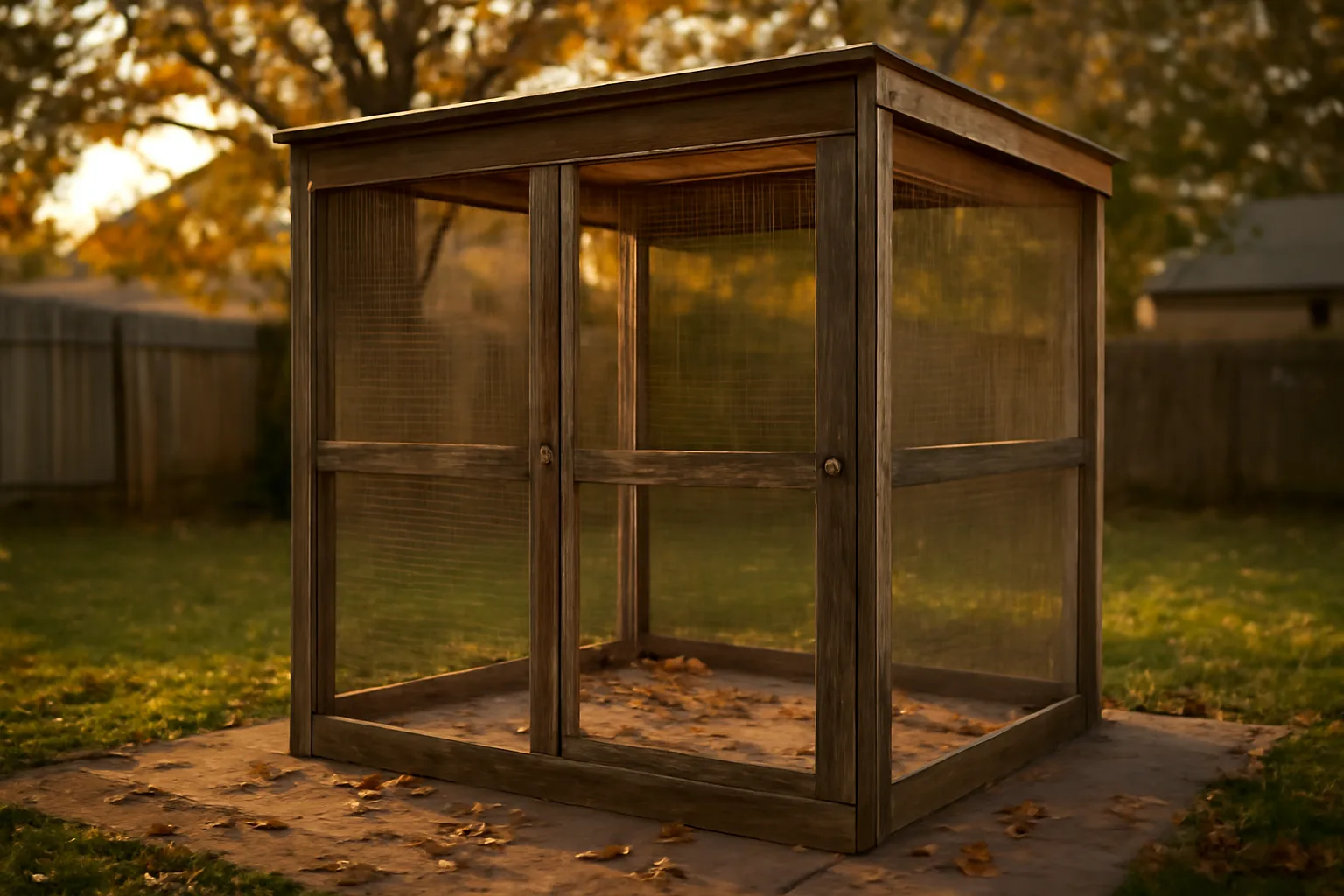
For songbirds: a minimum of 4 by 4 by 6 feet, hardware cloth no larger than 1/2 inch mesh, a concrete or hardware-cloth floor to keep rats from digging in, and perching at several heights. For raptors: 8 by 8 by 8 feet with a double-door entry, a solid roofline over at least part of the mew, and perches wrapped in artificial turf or rope to prevent bumblefoot. For waterfowl: a pool or tub deep enough to float in, with a ramp for exit.
The quarantine enclosure is the piece new applicants forget. You need a separate cage, visually and physically split from healthy animals, where new intakes spend their first 72 hours to two weeks. A garage cage works if it meets the predator-proof and escape-proof standards. If your application shows one big enclosure and nothing for quarantine, it gets rejected [8].
What Arkansas has in common with other states without a rehab board
Arkansas is one of a handful of states with no state wildlife rehab permit. Oklahoma and parts of the Southeast look similar, where federal Migratory Bird permits do the heavy lifting and mammals fall through the regulatory cracks. Compare that to California, where the Department of Fish and Wildlife runs a full rehab licensing program with facility inspections, or Florida, where the Fish and Wildlife Conservation Commission runs a documented permit system.
The practical difference is who you answer to. In a regulated state, your license number goes on your intake records and you report to the state every year. In Arkansas, you report to the federal regional office for birds and to nobody for mammals. That cuts paperwork. It also means nobody is checking whether mammal rehabbers in Arkansas vaccinate themselves, keep records, or euthanize humanely. It is a permissionless system, not a quality-controlled one.
Want to see how neighbors handle it? The Alabama wildlife rehab guide and the Florida guide are worth reading before you commit. Alabama is the closest comparison: a neighboring state with a similarly light state approach and a heavier federal permit requirement.
Step-by-step: get legal in Arkansas
1. Decide your species. Birds require the federal permit. Mammals technically require nothing at the state level, but you should still line up a vet sponsor for your own safety and the animal's welfare.
2. Find a vet sponsor and get the letter. This is the critical path item. Start this conversation before you spend a dollar on lumber.
3. Build your enclosure and quarantine setup. Take thorough photos. Download Form 3-200-10b from the USFWS ePermits portal and follow the instructions exactly [9].
4. Submit the application with the $100 fee (confirm the current amount, since the fee can change under 50 CFR 13.11) [3].
5. Wait 60 to 90 days. If they request corrections, respond inside the requested window, usually 30 days.
6. Once approved, set up your records system, buy your initial supplies, and take your first intake only if you have the time. A single baby bird needs feeding every 15 to 30 minutes during daylight for the first week. That is not a beginner-friendly first animal.
7. File your annual report to USFWS Region 4 every year and renew every five years. Miss either one and you lose the legal right to rehab birds in Arkansas.
What a new Arkansas rehabber actually spends money on
Most new rehabbers budget for the permit and the enclosure and forget the operating costs. Here is the honest first-year breakdown from current typical prices and the federal fee schedule. The $100 permit fee is fixed by regulation [3]. Everything else is an estimate, and Arkansas prices run lower than coastal states.
| Category | Low end | High end | Notes |
|---|---|---|---|
| Federal permit application | $100 | $100 | USFWS fee, confirm current schedule |
| Songbird flight enclosure (DIY) | $500 | $1,500 | Materials only |
| Raptor mew (DIY) | $2,000 | $5,000 | Larger footprint, double door |
| Quarantine cage or small enclosure | $100 | $400 | Garage setup works |
| Vet sponsor fee (if charged) | $0 | $300 | Not mandated, set by practice |
| Initial medical and food stock | $200 | $600 | Formula, syringes, heat lamps |
| IWRC or NWRA training course | $0 | $500 | Online intro courses available |
| Total first year | $900 | $8,100 | Most people land around $1,500 to $3,000 |
Nobody has published a survey of Arkansas rehabber startup costs. The table comes from the permit fee plus typical material pricing for the enclosure sizes USFWS expects. Rehab only mammals and build a simple outdoor squirrel cage, and your first-year cost can stay under $1,000.
Common mistakes that get Arkansas applications rejected
Incomplete enclosure photos top the list. USFWS reviewers see hundreds of applications a year, and the number one bounce reason is photos that fail to show dimensions, mesh size, or the quarantine area. Take 10 to 20 photos per enclosure from every angle. Include a close-up of the mesh with a ruler or tape measure next to it.
A missing or weak veterinarian letter is second. The letter has to say the vet agrees to sponsor your permit, not merely that they know you. "I have treated animals for this person and they seem competent" does not meet the sponsorship requirement. Send your vet the exact language USFWS wants, which is in the permit instructions [9].
Third: applying for a species group you have no experience with. If you have only ever worked with songbirds and your application asks for raptors, the reviewer will want proof of raptor-specific training or mentorship. Start with the species you actually know. You can amend later.
Fourth: ignoring record-keeping until your first intake. Set up your records system before animals arrive. USFWS can audit you at any time, and the annual report requirement means your records are the basis for your renewal.
Renewing and amending your permit in Arkansas
Migratory Bird Rehabilitation permits are valid for five years. Renewal means filing a new application with an updated vet letter, current enclosure photos, and your annual reports from the previous five years [6]. Miss an annual report and you fix it before you file the renewal, or the renewal drags.
Adding a species group, like moving from songbirds to raptors, is an amendment application with evidence of relevant training or mentorship. There is no additional fee for an amendment in most cases, but confirm with the regional office.
Changing your address means filing a change of address form. Move to a new property in Arkansas and you need new enclosure photos before the change is approved. Move out of Arkansas and you start over with the new state's requirements, which for most states means a state permit on top of the federal one. The Texas guide covers the most common Arkansas-to-Texas move, and note that Texas runs a full state permit system.
Is it worth it? The honest tradeoff
For birds: yes, if you have the vet sponsor and the time. The federal permit is a real credential, the standards mean something, and the work is genuinely needed in Arkansas, which has few permitted bird rehabbers outside Little Rock and Fayetteville. The $100 fee and the enclosure cost pay themselves back in the satisfaction of doing the work well.
For mammals: it comes down to your risk tolerance. No state oversight means no state accountability. You can rehab a raccoon litter in your garage with no paperwork, but you also have no legal structure when something goes wrong, when your vet refuses to sign off on a rabies exposure, or when a neighbor complains about the smell. Most experienced Arkansas rehabbers I have talked with want a state permit system for mammals, because it would push the bad actors out and give the good ones a credential to point to.
Some people should not do this. Anyone who cannot say no to an animal. Anyone who cannot euthanize an animal that will never be releasable. Anyone who expects to make money. Wildlife rehabilitation in Arkansas is unpaid work with real legal exposure. The $149 Enclosure Kit from WildlifeRehabPath can save you a weekend of measurement mistakes, but no product replaces the vet sponsor or the time. Start with the vet sponsor. Everything else follows from that.
Frequently asked questions
Does Arkansas have a wildlife rehabilitation board?
No. Arkansas has no state wildlife rehabilitation board and no state rehab permit. The federal U.S. Fish and Wildlife Service issues the only permit you need for birds, and no permit exists for mammals. Your oversight comes from the USFWS Region 4 permit office and your veterinarian sponsor.
Can I rehab a baby raccoon in Arkansas with no permit?
Legally, yes. Arkansas has no state permit for rehabbing mammals. You still should follow standard rehab protocols and find a vet sponsor for rabies vector species, and you must release the animal rather than keep it as a pet. Your county or city may have local ordinances restricting wildlife possession.
What is the USFWS permit form number for bird rehab in Arkansas?
Form 3-200-10b, the Migratory Bird Rehabilitation application. You file it through the USFWS ePermits system, and Arkansas is processed by the Region 4 office in Atlanta, Georgia. The form requires enclosure photos, a vet sponsor letter, and documentation of experience.
Can I rehabilitate deer in Arkansas?
Yes, with no state rehab permit, but AGFC has specific rules about possession and release of game animals, and deer in north Arkansas fall under chronic wasting disease management zones where moving live deer is restricted. Many rehabbers decline deer because of these complications.
Do wildlife rehabilitators in Arkansas get paid?
No. There is no state funding program for wildlife rehabilitators in Arkansas. Most rehabbers are volunteers who pay for food, enclosures, and medical care out of pocket. Some operate as 501(c)(3) nonprofits and can accept tax-deductible donations, but there is no salary or stipend.
What happens if I rehab birds in Arkansas without a federal permit?
You are violating the Migratory Bird Treaty Act, a federal law with civil penalties and potential criminal charges for knowing violations. USFWS enforcement does pursue unpermitted bird rehabbers, especially when animals are displayed or adopted out as pets. Confirm current penalty amounts with USFWS, since they are set by statute and updated over time.
Can I rehab hawks and owls in Arkansas with the standard migratory bird permit?
Yes, the Migratory Bird Rehabilitation permit can cover raptors, but you typically need to demonstrate raptor-specific experience or training in your application. Some applicants start with songbirds and amend to add raptors after a year or two of experience.
Does my vet sponsor need to live in Arkansas?
Yes. USFWS expects your sponsoring veterinarian to be licensed in Arkansas, because they are the one who will see your intake animals and sign health certificates if needed. A vet in a neighboring state does not meet the requirement in most cases.
How many wildlife rehabbers are there in Arkansas?
Nobody publishes this number. USFWS does not release state-by-state permit counts in a public database, and since mammal rehabbers have no permit at all, the total is unknown. The best available estimate is a few dozen active bird rehabbers statewide, based on regional conference attendance, but that is anecdotal.
Can I rehab an animal and then keep it as a pet in Arkansas?
No. Rehab is for release. Keeping a native wild animal as a pet is prohibited by AGFC regulations, and a Migratory Bird Rehabilitation permit explicitly prohibits retaining any bird for personal use. Non-releasable animals require a separate educational or possession authorization.
What training do I need to get the federal permit in Arkansas?
USFWS rules require appropriate experience but do not mandate a specific course. IWRC and NWRA both offer online introductory courses that cost between $0 and $500. Mentorship under an existing permitted rehabilitator is the strongest evidence, and your application should document it in detail.
Is the $100 USFWS fee the only fee in Arkansas?
Yes for birds, and there is no fee for mammals because there is no permit. The $100 federal application fee sits under 50 CFR 13.11, which authorizes the USFWS Director to set and update fees. Confirm the current amount before you file.
Can I rehab animals in my apartment in Arkansas?
Probably not for most species. USFWS enclosure requirements for birds assume an outdoor or dedicated indoor flight area, and most apartment leases prohibit the enclosures rehab requires. Mammal rehab in an apartment is technically possible for small species but creates noise, odor, and lease violation problems.
Who do I call if I find an injured animal in Arkansas?
Call AGFC or a local permitted rehabber. AGFC does not maintain a public rehabber directory, but the agency can point you to active rehabbers in your area. For injured birds, you can also call the USFWS Region 4 office for a list of permitted rehabbers in Arkansas.
Sources
- U.S. Fish and Wildlife Service, ePermits: Migratory Bird Rehabilitation application (Form 3-200-10b): The federal Migratory Bird Rehabilitation permit application is Form 3-200-10b, required for rehabilitating native birds in Arkansas.
- Arkansas Game and Fish Commission, Regulations: Arkansas Game and Fish Commission regulates possession and taking of native wildlife and has no rehab permit category.
- U.S. Fish and Wildlife Service, Code of Federal Regulations 50 CFR 13.11: Permit fees: The fee for a migratory bird rehabilitation permit is $100, set under 50 CFR 13.11.
- U.S. Fish and Wildlife Service, Migratory Bird Program: USFWS Migratory Bird Rehabilitation permits are processed by regional offices with typical timelines of 60 to 90 days.
- Arkansas Game and Fish Commission, Chronic Wasting Disease management: Arkansas Game and Fish Commission has CWD management zones with restrictions on moving live deer and testing requirements.
- U.S. Fish and Wildlife Service, Code of Federal Regulations 50 CFR 21.31: Rehabilitation permits: The federal regulation requires facilities adequate to properly care for the birds and appropriate experience for permit issuance.
- Arkansas Department of Health, Rabies Prevention and Control: Arkansas Department of Health warns against handling rabies vector species including bats, raccoons, and skunks.
- U.S. Fish and Wildlife Service, ePermits: Migratory Bird Rehabilitation permit instructions: USFWS permit instructions require separate quarantine facilities and detailed enclosure photos for approval.
- U.S. Fish and Wildlife Service, ePermits portal: Form 3-200-10b is filed through the USFWS ePermits portal, which hosts the permit application and instructions.