Last updated 2026-08-18
TL;DR
California requires a Wildlife Rehabilitation Permit from CDFW. Most people start as an Apprentice, which needs a passed exam but zero prior hands-on hours. Budget roughly $140 in state fees plus maybe $150 in study materials. A permit can be in hand within 3 to 6 months if you time the exam cycle. Moving to a General permit, the standard for independent work, adds 1,000 hours of supervised experience, usually a year or more.
Do you need a license for wildlife rehabilitation in California?
Yes. It's mandatory and the state enforces it. CDFW issues a Wildlife Rehabilitation Permit, and without one you cannot legally possess a native wild animal for care and release. The rule is blunt: "Any person who possesses a wild animal for the purpose of rehabilitation shall first obtain a Wildlife Rehabilitation Permit from the department" (14 CCR § 679.6) [1].
A veterinarian can give emergency stabilization without a permit. Past 48 hours, you need the state permit. There's no informal "volunteer" or "rescuer" loophole. If you feed, house, or treat a wild animal meaning to return it to the wild, the state wants a permit in hand. Unpermitted rehabilitation can draw a fine up to $1,000 and six months in county jail under Fish and Game Code § 12000.
You don't need a separate federal migratory bird permit to handle songbirds, waterfowl, or raptors here. Through a cooperative agreement with the U.S. Fish and Wildlife Service, your CDFW permit covers migratory birds automatically [2]. Endangered species like condors and sea otters, plus marine mammals, need separate federal authorizations. That's a different chapter.
How much does a wildlife rehabilitator cost in California?
The state keeps the initial license under $150. The real spending starts with enclosures, food, and vet bills. Here are the hard numbers from the 2024 to 2025 fee schedule [3].
| License Type | Fee |
|---|---|
| Apprentice | $88.96 |
| General | $115.41 |
| Veterinary | $57.71 |
On top of that, you pay a $53.50 nonrefundable examination fee when you apply to take the written test [4]. Fail and retake, and you pay the $53.50 again. Most people spend another $10 to $20 printing the CDFW study guide, though a free PDF is available.
Then comes the part nobody budgets for: enclosures. CDFW inspects your facility before issuing a permit, and you need a clean, secure setup. A minimal indoor cage plus a small outdoor flight pen runs $200 to $500 in materials. Buy pre-made aviaries or mammal pens and you cross $1,000 fast. Some first-year rehabbers drop $2,500 on materials and vet supplies before their first patient arrives. You can bootstrap it, though. WildlifeRehabPath sells a $149 State + USFWS Enclosure Kit with compliant plans for building inspection-friendly enclosures on a budget. It's not instant housing. It spares you the expensive trial and error.
A realistic startup budget: $150 in state fees, $150 in study materials, $300 in cage materials, plus a few hundred set aside for formula, syringes, and gas to pick up animals. Build your own cages and you can be operational for under $800. Long-term, plan on $1,000 to $3,000 a year per active facility, more if you need paid vet consults.
How long does it take to become a wildlife rehabilitator in California?
This is not a weekend workshop. CDFW holds the written exam only two or three times a year, at regional offices on announced dates. Miss a cycle and you might wait four months for the next one. After you pass, the application usually processes in 30 to 60 days, though some come back in three weeks and busy-summer applications can sit for ten. From "I want to do this" to holding an Apprentice permit, plan on three to six months.
The Apprentice license lets you work under a General permittee. To reach the General level, where you operate independently, you need 1,000 hours of documented hands-on wildlife care. A dedicated Apprentice working two or three days a week logs that in 12 to 18 months. Full-timers at a busy center can hit it in nine. So the path from zero to General, the real working license, usually lands near the two-year mark. Nobody can rush the hours. CDFW checks the log sheets carefully [5].
If you already hold a veterinary license, the timeline shrinks. You apply for a Veterinary permit and skip the exam and the experience hours, but you still need a facility inspection. That can turn around in 6 to 8 weeks.
What are the license classes in California?
CDFW offers three permit classes: Apprentice, General, and Veterinary. Apprentice permits let you work under direct supervision of a General permittee or vet. You can handle most small mammals (squirrels, opossums), songbirds, and waterfowl. Raptors, cervids, and bears need an added authorization or direct, on-site supervision from a General who holds those species.
A General permit lets you run your own facility, supervise Apprentices, and treat a wider range of species. You still need specific species endorsements for raptors, large carnivores, and cervids, and those require extra training and facility add-ons [6].
The Veterinary permit is for DVM holders who want to run a rehab facility or provide rehab care inside their practice. The fee is lower and you skip the exam. All three classes require a facility inspection before the permit goes active.
Compared to some states, California's structure is more tiered. Alabama, for one, puts less weight on tiered apprenticeship (see our guide on starting in Alabama). California's model does produce capable independent rehabbers, once you've put in the thousand hours.
What are the Apprentice license requirements?
The Apprentice permit is the entry point. You must be at least 18, hold a high school diploma or GED, and pass the written exam with a score of 80% or better [7].
The exam covers California and federal wildlife law, natural history, animal handling, nutrition, zoonotic disease, euthanasia criteria, and release protocols. CDFW provides an official study guide you can download free [8]. Study for at least a month, especially the legal and disease chapters. People fail when they skim those.
Submit the Examination Application (form FG1700 or the current equivalent) with the $53.50 fee. Once you pass, find a sponsor: a current General permittee willing to supervise you. The sponsor signs your permit application. Then you submit the permit application (form FG1699 or equivalent), the $88.96 fee, a facility diagram, and a sponsor agreement. CDFW schedules a facility inspection. The inspector checks cleanliness, security, species-appropriate housing, and quarantine space. Pass it, and the permit is issued.
After that, you keep a daily log of animals handled, file an annual activity report by January 31, and work under your sponsor's guidance. There's no fixed minimum number of hours to stay an Apprentice, but most people hold that permit for about a year before upgrading.
What are the General license requirements?
Upgrading to General is where you earn independence. You need three things: 1,000 hours of documented, hands-on wildlife rehabilitation experience as an Apprentice, at least one year holding the Apprentice permit, and a passing score on the General exam, again an 80% minimum [9].
The 1,000 hours must involve direct animal care. It can't be 500 hours of cage cleaning with no patient contact. CDFW reviews the log sheets. You also need written evaluations from your sponsoring General permittee plus another licensed rehabilitator or vet. The General exam goes deeper: more species identification, advanced nutrition, pharmacology, euthanasia decision trees, and facility management.
The application fee for the General permit is $115.41 [3], plus the $53.50 exam fee when you apply to take the test. Your facility must meet the more detailed standards in 14 CCR § 679.9, with species-specific sizes and security. The General inspection is usually more rigorous. If all goes well, the turnaround from exam to permit mirrors Apprentice: count on 30 to 60 days.
Why does facility setup matter so much?
Because an inspector will look at every pen. No permit gets issued without a facility that meets the minimum standards. CDFW wants an indoor hospital area, a separate quarantine space, outdoor pre-release enclosures, proper drainage, predator-proof construction, and a secure perimeter.
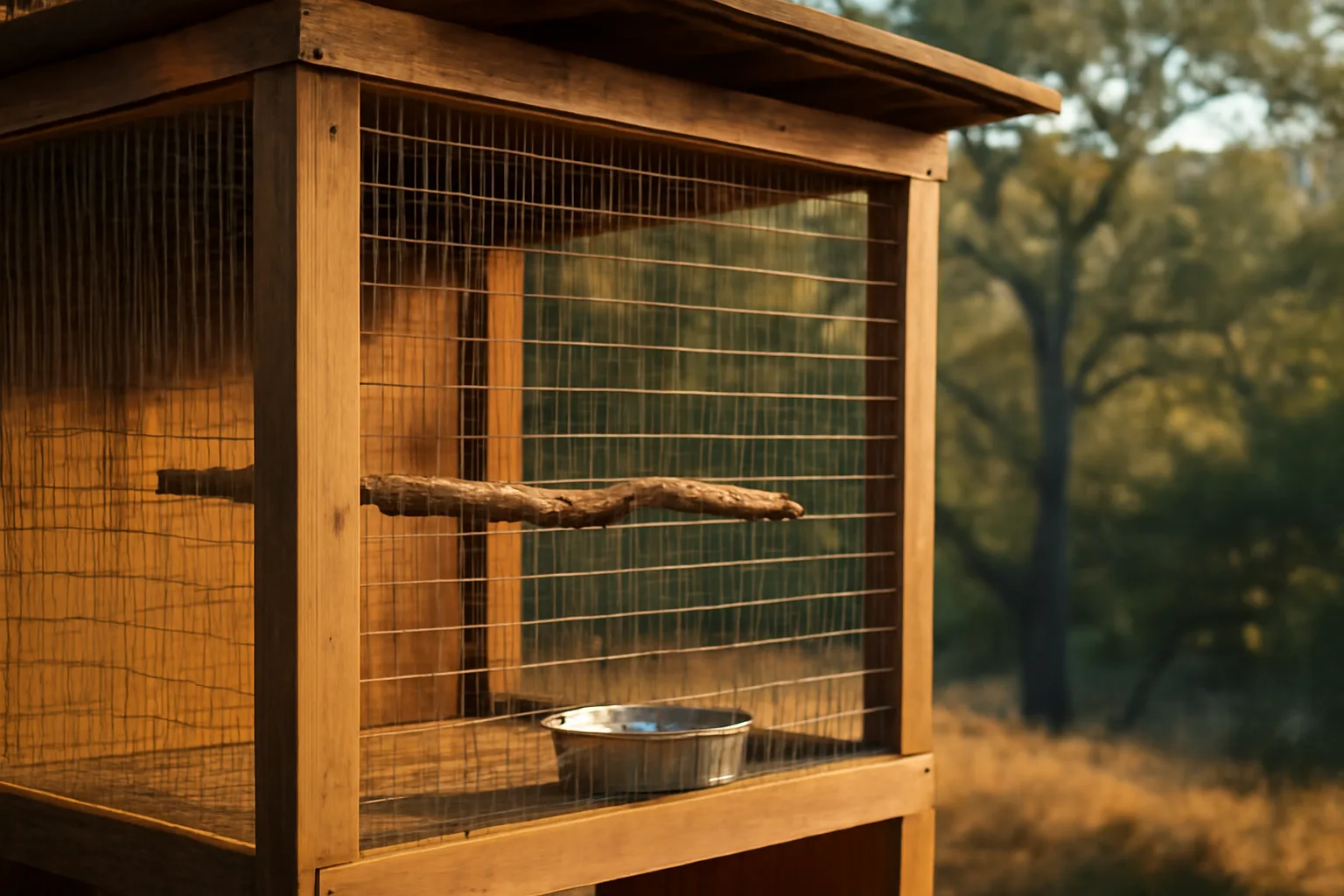
You can start small. A spare bedroom or garage bay can become a hospital room once you cover the floor in easy-to-sanitize material, add sinks, and install the right lighting. Outdoor cages need a roof, a solid floor or wire base to stop digging predators, and enough room for the animal to exercise. CDFW doesn't publish one master list of cage dimensions, but they expect species-appropriate sizing. A flight pen for a red-tailed hawk, for example, should be at least 8 feet long and 6 feet high. Undersize it and you'll fail the inspection.
Building from scratch costs less. A $149 enclosure kit like the one WildlifeRehabPath offers gives you exact plans that meet CDFW and USFWS specs. It's not a prefab cage. It's a design set you build with local materials. When the inspector asks where your dimensions came from, you point to a consistent standard. That alone has saved people a second inspection.
Before you pound a single post, check local zoning. Some cities and counties require a home occupation permit or a conditional use permit for wildlife care. One city in Southern California told a rehabber she needed a kennel license because she had coyote pups in an outdoor pen. Ask your planning department first. A $300 zoning fee beats a cease-and-desist order.
What is the application process step by step?
The steps are simple, but each one has paperwork and waiting.
1. Study the official guide. Download it from CDFW and focus on the regulations. Spend 4 to 6 weeks. 2. Apply for the exam. File the Examination Application with the $53.50 fee [4]. Pick a test date from the announced sessions. 3. Pass the exam. Score 80% or higher. Fail, and you reapply and pay again. 4. Secure a sponsor. A General permittee must agree to supervise you. Many Apprentices find sponsors by volunteering at a rehab center first. 5. Build your facility. Set up indoor and outdoor enclosures. Draw a facility diagram showing dimensions, materials, and waste handling. 6. Submit the permit application. Include the sponsor agreement, facility diagram, and $88.96 fee for Apprentice. 7. Schedule the inspection. CDFW contacts you to book a site visit. The inspector verifies everything matches the diagram. They may request minor changes. Fix them fast. 8. Receive your permit. Once signed off, the permit is yours. You can begin accepting animals under your sponsor's supervision.
For General, the path mirrors Apprentice but starts with 1,000 hours already in your logbook and uses the higher fee. The inspector may take a harder look at your species endorsements.
Do I need a separate federal permit for migratory birds?
No. California has a cooperative agreement with the U.S. Fish and Wildlife Service that extends migratory bird rehabilitation authorization to your state permit. The CDFW licensing page states: "Under a cooperative agreement with the U.S. Fish and Wildlife Service, California wildlife rehabilitation permittees are automatically authorized to rehabilitate migratory birds" [2].
That covers warblers, ducks, herons, hawks, owls, and more. You still comply with the federal reporting and disposition requirements, but CDFW's annual report form captures that data and satisfies USFWS.
One exception: bald and golden eagles. They're migratory birds, but the National Eagle Repository and eagle feather laws add rules. CDFW requires a specific eagle handling authorization for rehabbers who take in eagles. Ask about it during your General application. For marine mammals like seals and sea lions, you need a separate NOAA permit. The state permit doesn't touch marine mammals.
How do I maintain my license?
California permits expire annually. The renewal date is printed on your permit. Renewal fees match the initial fees: $88.96 for Apprentice, $115.41 for General [3]. You submit a renewal form plus a current facility diagram if anything changed.
Every year by January 31, you file an annual activity report covering every animal in your care during the previous calendar year: species, cause of admission, disposition (released, died, euthanized, transferred), and any disposition records [10]. The report is online and not complicated, but it forces you to keep accurate daily records. CDFW can audit those records, and if they don't match the report, you risk permit suspension.
For General permittees, continuing education isn't counted in hours, but stay current on disease outbreaks and new drugs. The CDFW Wildlife Health Laboratory sends bulletins. Read them. Your sponsor may also require you to attend workshops before turning you loose to full independence.
Frequently asked questions
Do you need a license for wildlife rehabilitator in California?
Yes. California requires a state-issued Wildlife Rehabilitation Permit for anyone who possesses a native wild animal for rehabilitation. The permit is mandated by 14 CCR § 679.6. Even a volunteer handling animals at a rehab center needs the permit unless working under the direct supervision of a permitted rehabber. Fines and jail time can apply for unpermitted activity.
How much does a wildlife rehabilitator cost in California?
Initial state fees total around $142: a $53.50 exam fee plus the $88.96 Apprentice permit fee. Enclosure materials and supplies add roughly $300 to $500 for a basic startup. Total outlay to get a permit and a working facility can stay under $800 if you build cages yourself. Annual renewal runs $88 to $115, plus food, vet, and maintenance costs that often hit $1,000 to $3,000 a year.
How long does a wildlife rehabilitator take in California?
Becoming a licensed Apprentice takes about 3 to 6 months, depending on exam scheduling and processing. To earn an independent General permit, add at least 1,000 hours of supervised experience, which most people complete in 12 to 18 months. The full path from beginner to General usually takes around two years. A veterinarian holding a DVM can get a Veterinary permit in 6 to 8 weeks with no exam.
Can I rehabilitate wildlife at my home in California?
Yes. Most small-scale rehabbers operate from a home-based facility. You designate a room or detached building as an indoor hospital area, plus outdoor enclosures. CDFW inspects the home facility before issuing a permit. Local zoning rules also apply, so check with your city or county about home occupation permits before you build.
What animals can I rehabilitate with an Apprentice license?
An Apprentice can care for common small mammals (eastern fox squirrels, opossums, cottontails), songbirds, and waterfowl under sponsor supervision. Raptors, bears, large carnivores, and cervids require added species authorizations and typically direct, on-site oversight by a General permittee who holds those authorizations. Your sponsor decides which species you're ready to handle.
Do I need a federal permit for migratory birds in California?
No. A cooperative agreement between CDFW and the USFWS automatically extends federal migratory bird rehabilitation authorization to holders of a valid California Wildlife Rehabilitation Permit. You do not file a separate USFWS application. Eagles require an added eagle handling authorization from CDFW because of federal repository rules.
How do I find a sponsor for my Apprentice license?
Start by volunteering at an established rehabilitation facility. Many centers take on volunteers who later become apprentices. Contact CDFW's regional wildlife rehab coordinator for a list of permitted rehabilitators near you. Build the relationship first. Sponsors want to see your husbandry skills and reliability before they sign the paperwork.
Is there a minimum age to become a wildlife rehabilitator in California?
Yes. You must be 18 to apply for any Wildlife Rehabilitation Permit class in California. Minors can volunteer at facilities under adult supervision, but they cannot hold a permit.
How often do I need to renew my California wildlife rehabilitation permit?
Annually. The permit expires one year from the date of issuance. Renewal requires a fee identical to the initial fee for your permit class and submission of any updated facility diagrams. You also file an annual activity report by January 31 each year.
Can I get a California wildlife rehabilitation permit with a felony record?
CDFW reviews criminal history during the application. A felony conviction doesn't automatically bar you, but the department weighs the nature of the offense, especially any wildlife or animal cruelty violations. Be ready to provide court records and a personal statement. A recent conviction for a wildlife offense will likely result in denial.
What is the passing score for the CDFW wildlife rehabilitation exam?
80%. Both the Apprentice and General written exams require a minimum score of 80 percent correct to pass. The exam mixes multiple-choice and true/false questions. Results are usually available within two weeks. Retakes cost another $53.50 examination fee.
Does California require continuing education for wildlife rehabilitators?
No formal CE hours are mandated by CDFW for permit renewal. Many sponsors and facilities do require apprentices to attend workshops. General permittees are expected to stay current on emerging diseases and regulation changes, and CDFW can ask for evidence of continued competence during inspection or audit.
Sources
- California Code of Regulations, Title 14, § 679.6 - Permit Required: Permit requirement: 'Any person who possesses a wild animal for the purpose of rehabilitation shall first obtain a Wildlife Rehabilitation Permit from the department.'
- CDFW Wildlife Rehabilitation Licensing Program: Cooperative agreement with USFWS automatically authorizes migratory bird rehabilitation; permit types and general requirements.
- CDFW 2024-2025 Wildlife Rehabilitation License Fee Schedule: Apprentice permit fee $88.96, General $115.41, Veterinary $57.71.
- CDFW Wildlife Rehabilitation Examination: Nonrefundable examination fee $53.50; exam application process.
- California Code of Regulations, Title 14, § 679.7 - Experience Requirements: General permit requires 1,000 hours of documented hands-on wildlife care experience.
- California Code of Regulations, Title 14, § 679.9 - Facility Requirements: Facility standards for enclosures, quarantine, and species-specific housing.
- California Code of Regulations, Title 14, § 679.8 - Examination: Exam requirements for Apprentice (80% passing score, content areas).
- CDFW Wildlife Rehabilitation Study Guide: Official study guide available for free from CDFW.
- CDFW Wildlife Rehabilitation Permit Application Forms: Application forms for exam registration and permit classes.
- CDFW Wildlife Rehabilitation Reporting: Annual activity report required by January 31; daily log obligation.